

Getting a vfd repair vs replacement cost analysis wrong is one of the most expensive mistakes a plant manager can make. A failed Variable Frequency Drive stops production cold, and the pressure to get back online fast often pushes teams toward the quickest option rather than the smartest one. This guide from Flexa Systems breaks down exactly how to evaluate repair versus replacement costs, so you make the decision based on total value, not just the sticker price on a new unit. Below, we'll walk through the full cost framework, hidden downtime factors, failure diagnosis, and the integration risks that most guides completely ignore.
Here's what most articles get wrong: they treat this as a simple math problem. It isn't.
A new VFD might cost less than you think. A repaired one might cost more than the quote suggests. The real answer lives in the gap between what you pay upfront and what the decision actually costs your operation over the next three to five years.
VFD Repair vs Replacement Cost Analysis: The Core Decision Framework
A Variable Frequency Drive is a motor control device that adjusts the speed and torque of an AC motor by varying the frequency and voltage of its power supply. When one fails, you face two paths: restore the existing unit to working condition, or purchase and install a new one. The right choice depends on several intersecting factors, not just the repair quote.
Start with the age and horsepower rating of the drive. A five-year-old 50 HP drive from a major OEM brand still has plenty of service life ahead of it. Repairing it almost always makes financial sense. A 15-year-old drive approaching end-of-life, with obsolete firmware and discontinued spare parts, is a different calculation entirely.
When Repair Is the Clear Winner
Repair wins clearly when the drive is less than ten years old, the failure is isolated to a single component such as an IGBT power module or a blown fuse, and the unit is from a supported brand. Component-level repair in these cases typically costs a fraction of replacement.
Repair also wins when the drive is deeply integrated into a larger control system. Swapping in a new unit often means reprogramming parameters, recalibrating sensors, and revalidating the entire system. That hidden labor cost can easily exceed the price difference between repair and replacement.
When Replacement Makes More Sense
Replacement becomes the better call when the drive has suffered catastrophic damage across multiple subsystems, when the model is discontinued with no parts available, or when the unit has already been repaired multiple times and is showing systemic degradation. If the repair quote exceeds roughly half the cost of a new equivalent drive, replacement deserves serious consideration.
Energy efficiency is another legitimate driver for replacement. Older drives running at lower efficiency ratings can cost more in electricity over three years than the price difference between repair and new.
Cost Breakdown: What You Actually Pay to Repair or Replace a VFD
The numbers here are where most vfd repair vs replacement cost analysis exercises fall apart, because people compare the wrong figures.
Repair costs typically include diagnostic fees, component replacement, labor, and testing. Many quality repair providers, including Flexa Systems, offer free diagnostics, which removes the evaluation cost from the equation entirely. The actual repair work on a mid-range drive generally runs significantly less than OEM replacement pricing.
Replacement costs include the new unit, shipping, installation labor, system reconfiguration, parameter programming, and commissioning time. On complex systems, that last category alone can add substantial cost that never appears on the purchase order.
How Horsepower Rating Affects Repair and Replacement Pricing
Horsepower rating is the single biggest driver of cost on both sides of the equation. A small 5 HP drive carries a much lower repair and replacement price than a 200 HP industrial unit. The relationship is not linear: repair costs scale more slowly with horsepower than replacement costs do, which means the cost-effectiveness of repair tends to increase as drive size grows.
For large HP drives, the savings from repair versus replacement are often dramatic. This is where component-level expertise matters most, because the IGBT power modules and control boards in high-HP drives are expensive components that a skilled technician can often restore rather than replace wholesale.
Repair vs Replacement Comparison Table
| Factor | Repair | Replacement |
|---|---|---|
| Upfront Cost | Lower (often 30-70% less) | Higher |
| Turnaround Time | 5-30 days (rush options available) | Days to months (OEM lead times) |
| Integration Risk | None (same unit) | High (reconfiguration required) |
| Warranty | Up to 2 years (third-party) | 1-2 years (OEM) |
| Energy Efficiency | Same as existing | Potentially improved |
| Parts Availability | May be limited for old units | Guaranteed for new models |
| Best For | Drives under 10 years old, isolated failure | End-of-life units, multi-system failure |
Downtime Cost Calculation: The Hidden Factor in Every VFD Decision
Downtime cost calculation is where the vfd repair vs replacement cost analysis gets real. The price of the drive itself is often the smallest number in the room.
Production loss during a VFD outage varies enormously by industry and application, but the daily cost of a stopped production line is rarely trivial. To calculate your actual downtime cost, multiply your hourly production value by the expected hours of downtime for each option.
Here is a practical framework:
Downtime Cost Formula: Total Downtime Cost = (Hourly Production Value) x (Expected Downtime Hours) + (Labor Cost During Downtime) + (Expedite Fees or Rush Charges)
Apply this to both scenarios. A new OEM drive might have a lead time of four to twelve weeks depending on model availability. A repaired unit from a specialist shop with rush service can return in 24 to 72 hours. That difference in turnaround time can make repair the dramatically cheaper option even if the repair quote itself is only modestly lower than replacement cost.
According to Automation World's coverage of industrial downtime costs, unplanned downtime in manufacturing carries costs that extend far beyond the immediate production loss, including quality escapes, expediting fees, and customer penalties.
VFD Troubleshooting Guide: Identifying Root Cause Before You Decide
The most common mistake in the repair-versus-replace decision is making it before you know what actually failed. A proper VFD troubleshooting guide starts with diagnosis, not assumptions.
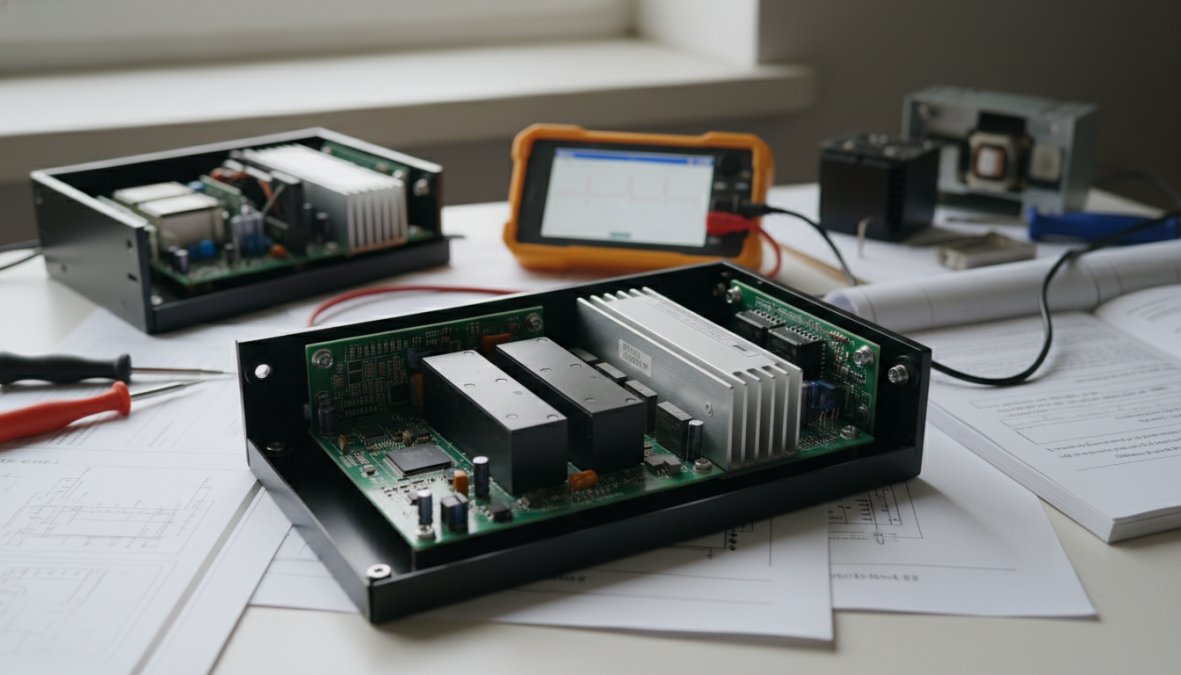
Many drives that appear completely dead have a single failed component. Conversely, some drives with partial functionality have sustained damage across multiple boards that makes repair economically unviable. You cannot know which situation you're in without a proper failure analysis.
Common Failure Points: IGBT Power Modules, Control Boards, and Cooling Fans
The three most common failure points in a Variable Frequency Drive are the IGBT power module, the control board, and the cooling fan system. Each has a different cost profile and a different implication for the repair decision.
IGBT power modules handle the high-voltage switching that converts AC to DC and back. They fail due to thermal stress, voltage spikes, and age. Replacing a single IGBT module is often the most cost-effective repair available, restoring full functionality at a fraction of replacement cost.
Control boards manage the logic, communication, and parameter storage of the drive. Failures here can range from a single failed capacitor to a completely corrupted processor. Component-level diagnosis is essential before assuming the entire board needs replacement.
Cooling fans are the most frequently overlooked failure point. A failed cooling fan causes thermal shutdown and, over time, secondary damage to power components. Fan replacement is one of the cheapest repairs possible. Missing it and replacing the entire drive is an expensive mistake.
Failure Analysis Steps: From Blown Fuse to Component-Level Diagnosis
A systematic failure analysis follows this sequence:
- Check input fuses and circuit breakers first. A blown fuse is sometimes the entire problem.
- Inspect the cooling fan for operation. A seized fan is a quick replacement.
- Read fault codes from the drive's display or diagnostic port if the unit powers up at all.
- Perform visual inspection of the control board for burned components, swollen capacitors, or corrosion.
- Test the IGBT power module with a multimeter or specialized tester for gate-to-emitter shorts.
- Evaluate the DC bus capacitors for capacitance loss, which is common in older drives.
- Send to a specialist for component-level bench testing if field diagnosis is inconclusive.
VFD Lifespan Expectancy and Lifecycle Cost Considerations
VFD lifespan expectancy under normal operating conditions typically falls between 10 and 20 years, but that range is almost useless as a decision input on its own. What actually matters is where your specific drive sits on its degradation curve and what the remaining economic life is worth relative to the cost of the intervention you are considering.
A structured Total Cost of Ownership (TCO) model is the tool that turns lifespan data into a real decision. Most repair-versus-replace guides skip this entirely and offer a cost table instead. A cost table compares today's prices. A TCO model compares the full financial consequence of each path over the remaining service horizon.
Building a TCO Model for Your VFD Decision
A practical TCO model for a VFD repair-versus-replace decision includes five cost categories on each side of the ledger:
1. Acquisition Cost For repair: diagnostic fee (often waived by specialist providers) plus component and labor costs. For replacement: purchase price of the new unit plus shipping.
2. Installation and Commissioning Cost For repair: typically zero, since the same unit returns to the same panel with the same parameters. For replacement: installation labor, parameter programming, system integration work, and any panel modifications required to fit the new unit. On complex systems, this category alone can represent 20-40% of the new drive's purchase price in additional labor.
3. Downtime Cost Calculated as: (Hourly Production Value) × (Expected Downtime Hours for Each Option). This is almost always the largest single number in the model and the one most frequently omitted from informal comparisons. Apply the actual lead time for each option, not the best-case scenario.
4. Ongoing Energy Cost For repair: the existing drive's efficiency profile continues unchanged. For replacement: calculate the efficiency delta between the old and new unit, apply it to annual operating hours and your local energy rate, and determine the annual savings. Divide the net cost premium of replacement by the annual energy savings to get the simple payback period. If the payback period exceeds the expected remaining service life of the new drive, energy efficiency does not justify replacement on its own.
5. Maintenance and Failure Risk Cost This is where drive age matters most. A drive in the first half of its service life carries a low annualized failure risk. A drive beyond year 12-15, particularly one that has already experienced one failure, carries a meaningfully higher probability of repeat failure. Assign a probability-weighted cost to a second failure event within the next three years for each option. A repaired mid-life drive with a root-cause fix has a low repeat-failure probability. A repaired end-of-life drive with systemic capacitor degradation has a high one.
Age-Based Decision Thresholds
While every situation is different, most practitioners working in industrial maintenance apply rough age-based thresholds as a starting filter before running the full TCO model:
| Drive Age | Default Starting Position | Override Conditions |
|---|---|---|
| 0-7 years | Repair strongly favored | Catastrophic multi-board failure, discontinued model |
| 7-12 years | Repair favored, run TCO model | Repeated failures, parts scarcity, major efficiency gap |
| 12-15 years | Neutral, TCO model required | Single isolated failure may still favor repair |
| 15+ years | Replacement favored | Isolated, inexpensive failure on a supported model may still justify repair |
These thresholds are starting points, not rules. A 14-year-old drive in a clean, climate-controlled environment with documented preventive maintenance history may have more remaining life than a 9-year-old drive that has run continuously in a high-ambient-temperature enclosure without a single maintenance event.
What Preventive Maintenance Actually Does to Lifecycle Cost
Preventive maintenance is the most underdiscussed lever in VFD lifecycle cost. The components that degrade predictably, DC bus electrolytic capacitors, cooling fans, and thermal interface materials on IGBT modules, are also the cheapest to replace proactively. A scheduled capacitor replacement at year 8-10 on a large HP drive costs a fraction of an emergency repair after thermal runaway has damaged the power stage.
Facilities that implement a VFD preventive maintenance program typically see two measurable outcomes: fewer unplanned failures (reducing the reactive decision pressure that leads to expensive choices), and better information about drive condition at the time of failure (because they have maintenance records that inform the TCO model).
According to the U.S. Department of Energy's guidance on motor and drive systems, lifecycle cost analysis for industrial motor systems should account for energy consumption, maintenance costs, and downtime risk over the full service life, not just acquisition cost. The DOE framework explicitly recommends against single-point cost comparisons for this class of equipment decision.
Integration Risks, Energy Efficiency ROI, and Supply Chain Lead Times
This is the section most vfd repair vs replacement cost analysis guides skip entirely. The three topics below, integration compatibility, energy efficiency payback, and supply chain lead times, are where the real decision often gets made, and where the most expensive surprises hide. Each deserves a structured treatment, not a paragraph.
Integration and Compatibility Risks When Replacing a VFD
Replacing a VFD is rarely a plug-and-play operation, and the gap between what appears on the purchase order and what the project actually costs is almost entirely explained by integration work. This risk is highest when replacing a legacy drive with a modern unit, even from the same manufacturer.
Communication Protocol Compatibility
Modern VFDs support current industrial protocols, EtherNet/IP, PROFINET, EtherCAT, but a drive installed a decade ago may be communicating over Modbus RTU, DeviceNet, or a proprietary serial protocol. A new drive may not natively support the legacy protocol your PLC is using. The resolution options are: purchase a protocol gateway or communication adapter module (adding cost and a new potential failure point), reprogram the PLC communication stack (requiring controls engineering time and a full revalidation cycle), or source a new drive that explicitly supports the legacy protocol (which may limit your vendor options significantly).
None of these options are free, and none of them appear on the drive purchase order.
Parameter Migration
A VFD that has been tuned to its application over years of operation may have hundreds of modified parameters, acceleration and deceleration ramps, current limits, PID loop gains, fault response behaviors, and application-specific logic. When you replace the drive, those parameters do not transfer automatically. If the original parameters were not documented (a common situation in facilities without rigorous change management), the recommissioning process requires a technician to retune the drive from scratch against the live process. For applications with tight process tolerances, tension control, positioning, or flow regulation, this can take days.
A repaired drive returns with its original parameters intact. That alone eliminates an entire category of recommissioning risk.
Physical and Electrical Footprint
Drive form factors change across product generations. A new drive may have a different mounting footprint, different terminal block locations, or different cable entry points than the unit it replaces. Panel modifications, drilling new mounting holes, extending cable runs, adding din rail sections, are not large costs individually, but they add up and they add time. In a UL-listed panel, any modification may also require re-inspection.
Motor Compatibility and Retuning
Modern drives with advanced sensorless vector control algorithms apply motor models that differ from older scalar or basic vector control approaches. A new drive connected to an older motor without proper autotuning may exhibit instability, overcurrent trips, or unexpected torque behavior at low speeds. The drive will work, but it will require a tuning session that a like-for-like repair does not.
Energy Efficiency ROI: A Calculation Framework
The energy efficiency argument for replacement is real but frequently overstated. Here is how to evaluate it honestly rather than accepting it as a given.
Modern VFDs do offer efficiency improvements over older designs, primarily through better IGBT switching characteristics, improved motor control algorithms that reduce motor losses, and more sophisticated harmonic mitigation. However, the magnitude of the improvement depends heavily on the age and design of the drive being replaced.
When the efficiency argument is strong:
- The existing drive is 15 or more years old and predates modern switching technology
- The drive is significantly oversized for its application and running inefficiently as a result
- The application runs at high load for many hours per day, amplifying any efficiency delta
- The facility has high energy costs per kWh
When the efficiency argument is weak:
- The existing drive is less than 10 years old (efficiency gains over this generation are modest)
- The application runs at partial load or intermittently
- The drive is correctly sized for its motor and application
A simple efficiency payback calculation:
- Identify the efficiency rating of the existing drive and the proposed replacement (available in manufacturer datasheets)
- Calculate the annual energy consumption difference: (Motor kW rating) × (Annual operating hours) × (Efficiency delta as a decimal) = Annual kWh savings
- Multiply annual kWh savings by your facility's energy rate to get annual dollar savings
- Divide the net cost premium of replacement over repair by the annual dollar savings to get the simple payback period in years
If the payback period exceeds five years, energy efficiency alone does not justify replacement for most industrial applications. Most practitioners find that for drives under 12 years old running at appropriate load levels, the efficiency payback period extends well beyond the practical planning horizon, making it a weak standalone justification for replacement.
Supply Chain Lead Times: The Emergency Variable That Changes Everything
Supply chain conditions for industrial VFDs have become a persistent planning challenge. OEM lead times for specific models vary from days to many months depending on drive series, horsepower rating, voltage class, and global component availability. Lead time volatility for power electronics, particularly IGBT modules and microcontroller components, has remained unpredictable in industrial markets, as documented in IEEE Spectrum's reporting on industrial electronics supply chains.
This variability has a direct and often decisive impact on the repair-versus-replace decision.
The lead time asymmetry:
A specialist repair provider with in-stock component inventory for major drive brands can typically return a repaired unit in 5 to 30 business days, with rush service available in 24 to 72 hours for critical applications. A new OEM unit for a specific model may carry a lead time of 8 to 20 weeks or longer during periods of supply constraint. That asymmetry, measured in weeks versus months, can make repair the only operationally viable option regardless of the unit cost comparison.
How to evaluate lead time risk before a failure occurs:
The best time to assess replacement lead time for your critical drives is before they fail, not after. Most OEM distributors will provide a current lead time estimate for a specific model on request. If the lead time for your most critical drive is already 12 or more weeks, that information should directly influence your spare parts strategy and your repair-versus-replace default position.
Facilities that maintain a documented critical drive inventory, knowing exactly which models are installed, which are still supported, and what the current replacement lead time is, make significantly better decisions under failure pressure than those encountering this information for the first time during a production outage.
The spare drive option:
For truly critical applications where neither a long repair turnaround nor a long OEM lead time is acceptable, a third path exists: maintaining a refurbished spare drive on the shelf. A quality repair provider can often supply a tested, warranted refurbished unit for a specific drive model at a cost well below new OEM pricing. This eliminates lead time risk entirely for the most critical assets and is worth evaluating as part of any serious VFD lifecycle strategy.
Warranty and Reliability: Comparing Repaired vs New VFDs
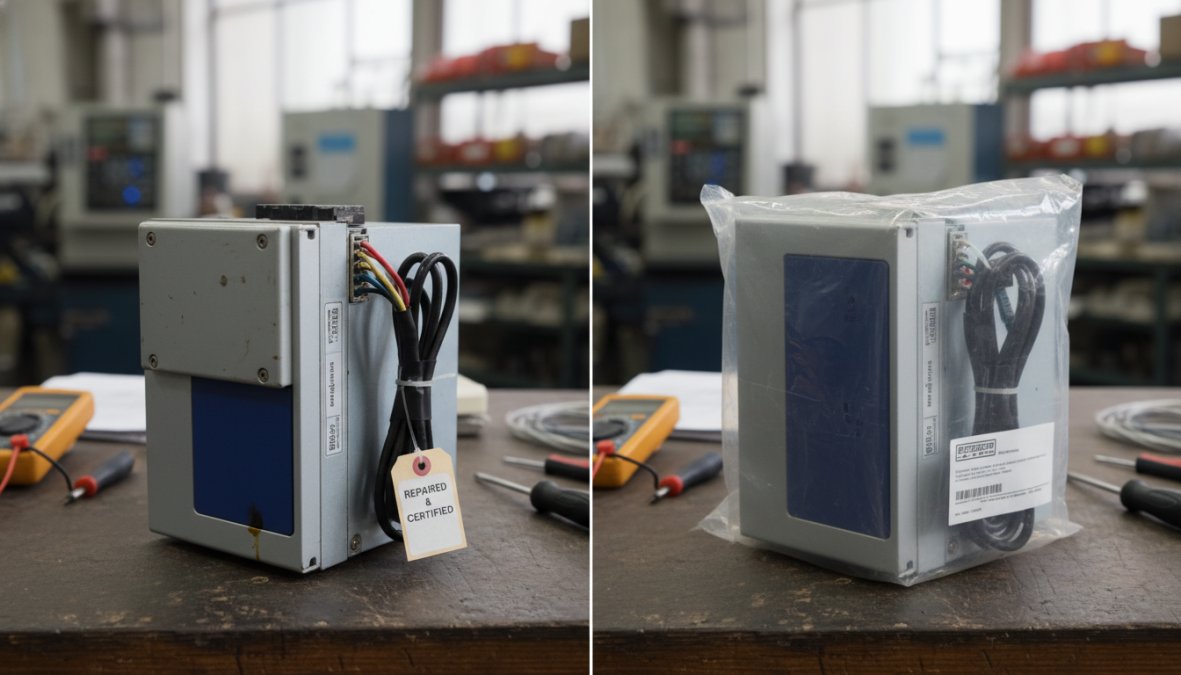
The warranty comparison between repaired and new VFDs is more nuanced than most buyers expect.
A new OEM drive typically carries a one to two year warranty covering manufacturing defects. What it does not cover is installation damage, parameter errors, or failures caused by the application environment. OEM warranty claims also typically require returning the unit to an authorized service center, which reintroduces lead time into the equation.
A quality third-party repair provider like Flexa Systems offers a two-year warranty on all repair work, covering the repaired components and the workmanship. This warranty is often comparable in duration to OEM coverage and, in practice, may be faster to act on because the repair provider has direct knowledge of what was done to the unit.
Reliability after repair depends entirely on the quality of the repair process. Component-level repair that replaces failed parts with quality equivalents and includes full-load testing before return delivers reliability comparable to new equipment. Fault code resets or superficial repairs without root cause diagnosis do not, and are a false economy.
The real reliability question is not "repaired or new?" It is "who did the repair and what did they actually fix?"
Full VFD Repair vs Replacement Cost Analysis: Making Your Final Call
Pulling the complete vfd repair vs replacement cost analysis together requires working through a structured process rather than making a gut call under pressure.
Step-by-Step Decision Process
Use this framework when a VFD failure occurs:
Step 1: Get a proper diagnosis before deciding anything. Send the unit for evaluation or have a technician perform on-site failure analysis. Do not make a repair-versus-replace decision based on fault codes alone.
Step 2: Calculate your downtime cost per day. Multiply hourly production value by daily hours of operation. This number reframes the entire decision.
Step 3: Get both a repair quote and a replacement quote with lead times. The lead time on a replacement is as important as the price. A repair quote from a specialist with rush capability often wins on total cost even if the unit price is similar.
Step 4: Assess drive age and remaining lifecycle. Drives under ten years old with isolated failures are strong repair candidates. Drives over fifteen years old with multiple failure modes deserve a harder look at replacement.
Step 5: Evaluate integration complexity. If replacing requires protocol adapters, panel modifications, or significant parameter work, add that cost to the replacement quote before comparing.
Step 6: Check parts availability for repair. For older or less common models, verify that the repair provider has access to the necessary components. This is where a specialist with broad component inventory has a real advantage.
Step 7: Compare total cost of ownership, not just unit cost. Add repair or replacement cost, downtime cost at each option's lead time, and integration labor. The lowest total number wins.
According to Plant Engineering's guidance on predictive maintenance and repair decisions, facilities that apply structured decision frameworks to equipment repair versus replacement consistently achieve lower total maintenance costs than those making reactive decisions under production pressure.
Most facilities face VFD failures without a clear framework for evaluating the true cost of each option, and that pressure leads to expensive reactive decisions. Flexa Systems provides free diagnostics, component-level repair for all major VFD brands, and a 2-year warranty on all work, with 24-72 hour rush service available to minimize production loss. For most mid-life drive failures, repair through Flexa Systems delivers savings of up to 70% compared to new equipment while matching or exceeding OEM warranty coverage. Get a quote from Flexa Systems and make your next VFD decision based on total cost, not just the purchase price.
Frequently Asked Questions
How much does VFD repair cost compared to buying a new unit?
VFD repair typically costs 30% to 60% less than purchasing a new replacement unit, with some component-level repairs saving up to 70% versus new equipment. The exact savings depend on the drive's horsepower rating, the failed components, such as an IGBT power module or control board, and the repair provider. For a full vfd repair vs replacement cost analysis, always request a free diagnostic evaluation before committing to either path.
How long do VFDs typically last, and when does age affect the repair decision?
VFD lifespan expectancy generally ranges from 7 to 15 years depending on operating environment, load conditions, and how consistently preventive maintenance is performed. Drives operating in high-heat or high-vibration environments tend to fail sooner. Once a drive exceeds 10 years, it's worth assessing whether spare parts are still available and whether the OEM still supports the model before committing to repair over replacement.
What are the most common signs of VFD failure?
Common failure indicators include erratic motor control, unexpected fault codes, a blown fuse, overheating due to a failed cooling fan, and complete loss of output. In a sensorless vector drive, you may also see speed instability or torque irregularities. Running a structured VFD troubleshooting guide, starting with a diagnostic evaluation, helps pinpoint whether the issue is a failed IGBT power module, a damaged control board, or a simpler electrical component before deciding on repair or replacement.
Does repairing a VFD affect warranty coverage?
A repair from a qualified third-party provider does not automatically void your equipment warranty on other system components, but it does replace the OEM's original drive warranty with the repair provider's own warranty. Reputable repair services, including component-level specialists, typically offer a 2-year warranty on all repair work, which can match or exceed the remaining OEM warranty on an aging drive. Always confirm warranty terms before approving any repair.
When should you choose replacement over repair for an industrial VFD?
Replacement is usually the better choice when repair costs exceed 60-70% of a new unit's price, when the drive model is discontinued with no spare parts available, when the system requires a retrofit to meet new energy efficiency standards, or when repeated failures signal systemic issues beyond a single component. Significant integration or system reconfiguration requirements with a new drive should also be factored into the total cost of ownership before deciding.
How do supply chain lead times factor into the repair vs replacement decision?
New VFD lead times from OEM channels can range from several weeks to several months depending on the model and current supply chain conditions. In contrast, a qualified repair service can often return a drive within 5 to 30 business days, with 24-72 hour rush service available for critical production situations. When production loss costs are high, the faster turnaround time of a repair versus waiting for a new unit can make repair the clearly more cost-effective path.