

Last Updated: May 29, 2026
Unplanned equipment downtime costs industrial facilities far more than the price of a replacement drive. When a variable frequency drive fails, every hour offline translates directly to lost production. Flexa Systems has helped hundreds of facilities across the country recover from drive failures faster and at a fraction of replacement cost through professional vfd repair services. Below, we'll show you exactly how the repair process works, how to troubleshoot common faults before sending your drive in, and how to decide when repair makes more sense than replacement.
The core argument running through this guide: most facilities replace drives when they should repair them, and they do it because they don't have a clear framework for making that call. That gap costs real money.
What Professional VFD Repair Services Actually Cover
Professional vfd repair services go well beyond swapping a failed board for a new one. At the component level, a qualified technician identifies the root cause of failure, replaces only the damaged components, and verifies the entire drive performs to OEM specifications before it ships back. This approach consistently delivers better long-term reliability than simple board replacement, because it addresses why the failure happened rather than just the visible symptom.
Component-Level Repair vs. Board Swapping
Board swapping is fast and easy. It's also the approach most likely to produce a repeat failure six months later.
Component-level repair means a technician traces faults down to individual capacitors, IGBTs, gate drivers, control cards, terminal cards, and power modules. A failed IGBT module, for example, often damages surrounding gate resistors and drive circuitry. Replacing only the IGBT without inspecting adjacent components is a shortcut that shows up again on your maintenance log.
Quality vfd repair services include:
Full disassembly and visual inspection of circuit boards
Capacitor testing and replacement where electrolytic degradation is found
IGBT and power module testing under load conditions
Control card and terminal card verification
Firmware restoration to OEM specifications
Thermal imaging to identify heat-related damage not visible to the eye
Pro TipRequest a repair report that lists every component replaced and tested. Reputable providers include this as standard documentation. If a shop can't tell you what they found, you don't know what you're getting back.
Brands Serviced: ABB, Allen-Bradley, Siemens, Yaskawa, and More
The best repair facilities handle virtually every major drive manufacturer. The most commonly serviced brands include ABB, Allen-Bradley (Rockwell Automation), Siemens, Yaskawa, Schneider Electric, and Danfoss. Each manufacturer uses proprietary control architectures, which means technicians need OEM schematics and manufacturer-specific test procedures to repair drives correctly.
Facilities running legacy equipment benefit most from repair. Drives from discontinued product lines are often impossible to replace with identical units, making component-level repair the only viable path to keeping existing motor control systems running.
The Diagnostic and Testing Process: What Happens to Your Drive
Every professional vfd repair service starts with a structured diagnostic phase, not a parts order. The diagnostic process determines whether a drive is repairable, what the failure mode was, and what the repair will cost before any work begins.
A technician in a clean industrial repair lab closely inspecting a variable frequency drive circuit board under bright overhead lighting, with diagnostic test equipment and oscilloscopes visible in the background.
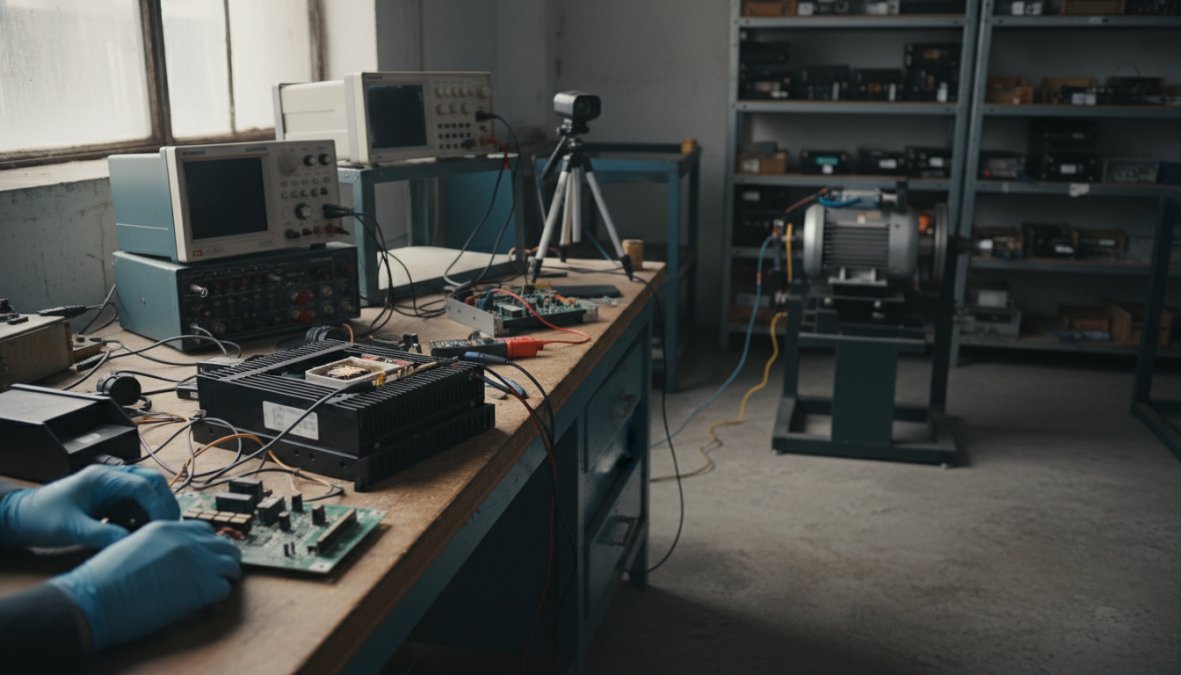
A technician in a clean industrial repair lab closely inspecting a variable frequency drive circuit board under bright overhead lighting, with diagnostic test equipment and oscilloscopes visible in the background
Failure Analysis and Root Cause Identification
Root cause identification is the step most shops skip. Without it, a repaired drive returned to the same operating environment will fail again for the same reason.
Common root causes include:
Overvoltage transients from utility switching events or poorly rated input line reactors
Overtemperature from blocked airflow, failed cooling fans, or undersized enclosures
Moisture and contamination from condensation, coolant leaks, or inadequate IP ratings
Input phase loss causing unbalanced DC bus voltage and IGBT stress
Short circuits in the connected AC induction motor that back-feed damage into the inverter section
A proper failure analysis includes visual inspection, thermal history review (burn marks, discoloration), capacitor ESR testing, and in many cases, a review of the fault log stored in the drive's non-volatile memory. That fault log is often the most direct evidence of what happened.
Load Testing and Closed-Loop System Verification
Bench testing a drive without a load proves almost nothing. A drive that powers up cleanly on the bench can still fail under the torque demands of actual motor speed control in a closed-loop system.
Load testing connects the repaired drive to a dynamometer or equivalent load bank, runs it through the full speed range, and verifies output voltage waveforms, current balance across all three phases, and thermal performance under sustained load. According to the IEEE standards for industrial electronics testing, load testing under rated conditions is the only reliable method for verifying inverter output quality before returning equipment to service.
This is the difference between a drive that works and a drive you can trust.
Common VFD Error Codes and What They Signal
Common VFD error codes fall into five broad categories: overcurrent faults, overvoltage faults, undervoltage faults, overtemperature faults, and ground fault conditions. Each category points to a different failure zone in the drive or the connected system.
Fault Category |
Typical Code Examples |
Most Likely Cause |
|---|---|---|
Overcurrent (OC) |
OC1, OC2, OC3 |
Motor winding fault, short circuit, rapid acceleration |
Overvoltage (OV) |
OV, DC Bus High |
Regenerative load, deceleration too fast, utility spike |
Undervoltage (UV) |
UV, DC Bus Low |
Input phase loss, weak supply, loose terminal connection |
Overtemperature (OH) |
OH1, OH2 |
Blocked airflow, failed cooling fan, ambient too high |
Ground Fault (GF) |
GF, Earth Fault |
Motor insulation failure, cable damage, moisture ingress |
Watch OutAn overcurrent fault that clears on reset but returns within hours almost always indicates a developing motor winding fault, not a drive problem. Sending the drive in for repair without testing the motor first leads to repeat failures and wasted repair costs.
DIY Troubleshooting Steps Before Sending Your Drive In
Before shipping a drive for professional vfd repair service, a few on-site checks can save time and occasionally resolve the fault without any bench work.
Step 1: Document the fault code and operating conditions. Note the exact fault code, the load the drive was running, and any recent changes to the system (new motor, wiring work, utility event).
Step 2: Check input power quality. Measure all three input phases for voltage balance. A phase imbalance greater than 2% is enough to cause drive faults and damage over time.
Step 3: Inspect the motor. Use a megohmmeter to test motor insulation resistance to ground. Readings below 1 MΩ indicate insulation degradation that will damage a repaired drive immediately upon return to service.
Step 4: Inspect the drive enclosure. Check cooling fans, air filters, and heat sink fins. Blocked airflow is one of the most common and most preventable causes of drive failure.
Step 5: Check all terminal connections. Loose power terminals cause arcing, voltage spikes, and heat damage. Retorque all connections to the manufacturer's specified torque values.
If the fault persists after these checks, the drive needs bench diagnostics that on-site troubleshooting can't provide.
VFD Repair vs Replacement Analysis: A Practical Decision Framework
The vfd repair vs replacement analysis is the decision most facilities make badly, usually because they make it under pressure, without a structured method, and with incomplete cost data. This section gives you a repeatable framework you can run in under 30 minutes before committing to either path.
The Five Inputs You Need Before Making the Call
Before any cost comparison is meaningful, you need five pieces of information:
Current replacement cost, Get an actual quote for a new equivalent drive, not a catalog list price. Lead times matter here too: a new drive that ships in 16 weeks has a very different effective cost than one that ships in two days.
Repair estimate, A reputable shop provides a firm repair quote after free diagnostics, typically within 24-48 hours of receiving the unit. Do not compare repair cost against replacement cost until you have a real repair number.
Drive age and thermal history, A drive under 8 years old in a clean, temperature-controlled environment has a very different remaining service life than a 12-year-old unit that has been running at the top of its ambient temperature rating.
Remaining life of the connected system, Repairing a drive that will be decommissioned with the rest of the line in 18 months is a different calculation than repairing one tied to a motor and gearbox with a decade of service ahead.
Downtime cost per hour, This is the number most facilities don't track but should. In continuous process environments, downtime costs can reach thousands of dollars per hour. That figure changes the math on expedited repair options dramatically.
The Decision Matrix
With those five inputs in hand, apply this framework:
Scenario |
Recommended Path |
Reasoning |
|---|---|---|
Repair cost < 40% of replacement, drive < 10 years old |
Repair |
Strong financial case; drive has meaningful remaining life |
Repair cost 40-65% of replacement, connected system life > 3 years |
Repair |
Still positive ROI when amortized over remaining system life |
Repair cost 65-80% of replacement, drive > 12 years old |
Evaluate carefully |
Run the lifecycle check below before deciding |
Repair cost > 80% of replacement |
Replacement likely |
Unless drive is obsolete with no equivalent available |
Drive model discontinued, no new equivalent |
Repair or refurbished unit |
Full system redesign cost almost always exceeds repair cost by a wide margin |
Repeated failures of same component within 12 months |
Replacement |
Indicates systemic issue repair alone won't resolve |
Watch OutThe 50% rule of thumb you'll see on most VFD service sites is a starting point, not a decision. It ignores drive age, system life, downtime cost, and parts availability, four variables that routinely flip the correct answer. Use the full matrix.
The Lifecycle Check: Four Questions Before You Commit to Repair
Before authorizing repair on any drive over 8 years old, run through these four questions:
Q1: Have the electrolytic capacitors already been replaced? Capacitors are the finite-life component in most VFDs. If they've already been replaced once and are showing degradation again, the drive is approaching end of economic life regardless of what else is repaired.
Q2: Is the failure mode recurring? A drive that has failed for the same root cause twice in three years is telling you something about its operating environment or its fundamental condition. Repair without addressing root cause is a short-term fix.
Q3: Are OEM spare parts still available? For drives from discontinued product lines, confirm that the repair shop has or can source the specific IGBTs, gate driver ICs, and control cards your unit requires. A repair quote that depends on salvaged components from other failed units carries higher risk than one using new OEM or equivalent parts.
Q4: Does the drive's control capability still match the application? Older drives may lack the communication protocols, encoder feedback options, or functional safety features that a modernized system now requires. If the application has evolved beyond the drive's capabilities, repair extends a mismatch rather than solving it.
If you answer yes to two or more of these questions, replacement deserves serious consideration even when the repair cost percentage looks favorable.
Sustainability and Environmental Impact of Repairing vs. Discarding
This is the angle most vfd repair guides ignore entirely, and it's worth stating directly: discarding a repairable drive is an environmental decision as much as a financial one.
A variable frequency drive contains significant quantities of copper, aluminum, rare earth materials used in capacitors, and hazardous substances including lead solder in older assemblies. According to the EPA guidelines on industrial electronics disposal, improper disposal of industrial electronics contributes to heavy metal contamination in landfills.
Repairing a drive extends its useful life by years and keeps those materials in productive use. For facilities with sustainability reporting requirements or ESG commitments, a documented repair-first policy for industrial electronics is a measurable contribution to waste reduction goals. The environmental case for repair aligns directly with the financial one.
Key TakeawayThe most defensible repair-vs-replacement decision is one you can document: repair estimate in hand, replacement quote in hand, drive age and failure history on record, and connected system life assessed. A decision made with all five inputs is one you can justify to operations management and revisit confidently at the next failure event.
Turnaround Time, Onsite Service, and Expedited VFD Repair Options
Turnaround time is the variable that determines whether a VFD repair service actually solves your downtime problem or just defers it. Understanding how repair timelines are built, and where they can be compressed, lets you make a faster, better-informed decision when a drive fails.
How Standard Repair Timelines Are Built
A standard bench repair timeline has four sequential phases, and delays in any one of them cascade into the total:
Transit inbound, Typically 1-3 business days depending on shipping method and distance. This phase is entirely within your control.
Intake and diagnostics, A reputable shop completes initial diagnostics within 24-48 hours of receiving the unit and issues a repair quote. Shops that take longer than 48 hours for a diagnostic quote are often understaffed or triaging a backlog.
Bench repair, Component-level repair on a standard drive frame typically takes 2-5 business days. Complex failures involving multiple subsystems, or drives requiring sourced components, extend this window.
Load testing and quality verification, Full load testing under rated conditions adds 4-8 hours to the repair cycle. This step should not be skipped to compress the timeline.
Total standard turnaround from receipt to ship-back: 5-30 business days for most drive sizes and failure modes. Add transit time in both directions and a facility 500 miles from the repair shop is looking at roughly two weeks door-to-door on a standard service level.
Expedited Service: What It Actually Means
Expedited repair is not just standard repair with a rush fee attached. A genuine rush capability requires the shop to have bench capacity held in reserve, technicians available for extended-hours work, and a parts inventory deep enough to avoid sourcing delays on common failure components.
Flexa Systems offers 24-72 hour rush service for critical applications. To make that timeline realistic on your end:
Ship overnight or two-day freight, A drive that arrives on a Tuesday via ground shipping after a Monday failure has already lost two days before diagnostics begin.
Call ahead, Notifying the repair shop before the drive ships allows them to pre-stage bench capacity and confirm parts availability for your specific model.
Include complete fault documentation, A written description of the fault code, operating conditions at failure, and any recent system changes allows the technician to begin root cause analysis before the drive is even on the bench, compressing the diagnostic phase.
Confirm load testing is included, Some shops offer a faster turnaround by skipping full load testing. This is a trade-off worth understanding explicitly, not discovering after the fact.
Pro TipFor facilities where a single drive failure can halt an entire production line, the cost of maintaining a fully tested spare drive on the shelf is almost always lower than the cost of even one emergency repair cycle. Ask your repair provider about a spare drive program: they evaluate, certify, and store a tested spare for your critical drives, ready to swap immediately while the failed unit goes through standard repair.
Onsite vs. Offsite Repair: A Practical Decision Guide
The onsite vs. offsite choice is not simply about drive size. It involves logistics, diagnostic capability, and the nature of the failure itself.
Choose onsite repair when:
The drive is a large frame unit (typically above 200 HP) where safe crating and shipping requires significant effort and cost that approaches or exceeds the repair estimate
The failure involves system integration issues, communication faults, PLC interface problems, parameter mismatches, that require the drive to be diagnosed in context with the connected equipment
The facility cannot absorb the transit time on top of bench time, and a qualified technician can be on-site faster than a round-trip ship cycle
The drive is installed in a location where removal requires significant mechanical work (confined spaces, integrated panel assemblies)
Choose offsite bench repair when:
The drive is a standard frame size that ships safely in OEM packaging or a properly padded crate
The failure is clearly internal to the drive (power section fault, control card failure, capacitor degradation) rather than a system integration issue
Full load testing on a dynamometer is required, this equipment is not practical to bring on-site
The repair involves component-level work requiring a controlled environment, microscopy, or specialized soldering equipment
For most facilities running drives below 100 HP, offsite repair with expedited turnaround is the fastest and most cost-effective path. The key variable is not drive size alone but whether the failure mode can be fully diagnosed and verified without the connected system present.
Packaging and Shipping Your Drive: What Gets It There Safely
A drive that arrives damaged from inadequate packaging adds days to the repair timeline and can create disputes about pre-existing damage. Follow these guidelines:
Use the OEM shipping carton if available. It was designed for the drive's weight distribution and fragile components.
If the OEM carton is not available, use a double-wall corrugated box with a minimum of 3 inches of foam or bubble wrap on all six sides.
Remove or secure any external accessories (operator panels, external braking resistors) separately.
Include a printed fault description and contact information inside the package, not just on the label.
Photograph the drive before packaging to document its condition at shipment.
Use a carrier that provides tracking and proof of delivery. For drives above a certain value, declared value coverage is worth the additional freight cost.
Key TakeawayThe total downtime clock starts when the drive fails, not when it arrives at the repair shop. Cutting transit time through overnight shipping and calling ahead to pre-stage bench capacity are the two actions entirely within your control that most consistently compress the real-world time from failure to back-in-service.
VFD Maintenance Best Practices to Prevent Costly Failures
Preventive maintenance is the most cost-effective VFD repair service you'll never need to use. Most drive failures are preventable. The ones that aren't are at least detectable before they become catastrophic.
A structured VFD preventive maintenance program includes:
Quarterly inspection of cooling fans and air filters
Annual cleaning of heat sink fins and internal air passages
Annual torque check of all power and control terminal connections
Annual capacitor health check (capacitance and ESR measurement)
Annual thermal imaging of the drive under load to identify hot spots
Periodic review of drive fault logs for trending fault conditions
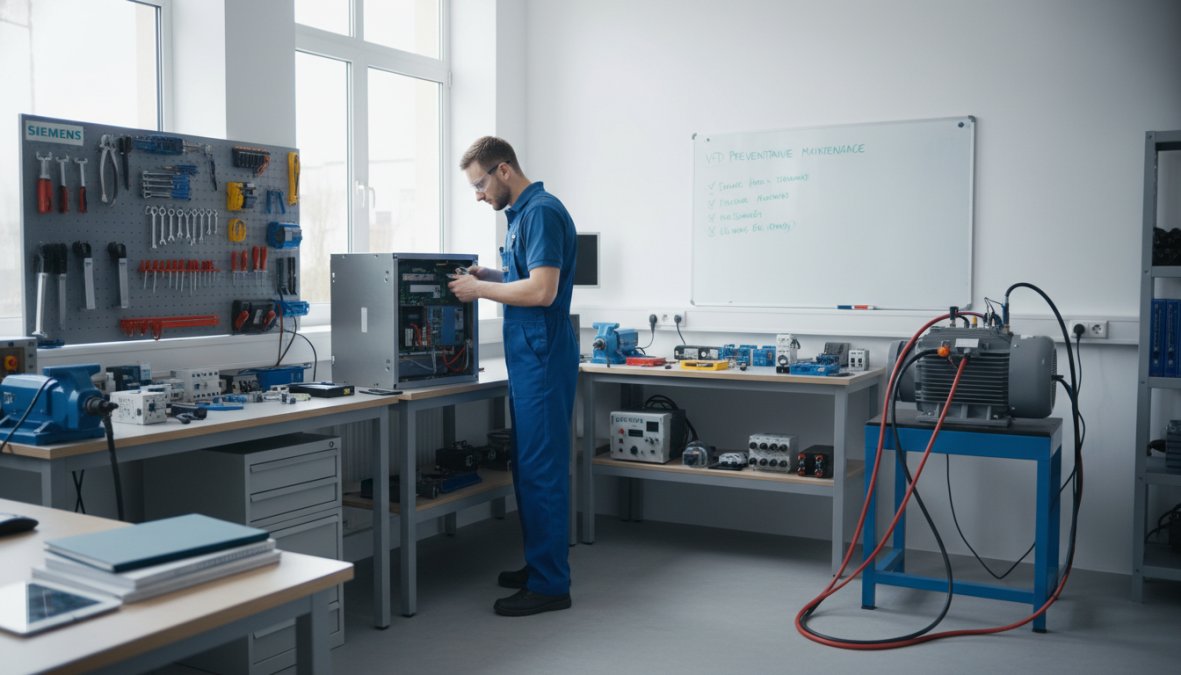
A maintenance engineer in a hard hat and safety vest checking a VFD control panel inside an industrial facility, writing notes on a clipboard, with motor control equipment and cable trays visible in the background
According to NEMA guidelines for variable speed drive maintenance, electrolytic capacitors in VFDs have a finite service life that degrades faster at elevated temperatures. A drive running at 40°C ambient will have capacitors that age significantly faster than one running at 25°C. Addressing the thermal environment extends drive life more than any other single maintenance action.
Key TakeawayThe single most impactful VFD maintenance action is controlling the thermal environment. Keeping drive enclosure temperatures within OEM specifications extends capacitor life and reduces the probability of catastrophic failure by a meaningful margin.
VFD Lifecycle Management: Knowing When Maintenance Isn't Enough
Every drive has a service life, and the honest answer is that maintenance can extend it but not indefinitely.
Signs that a drive has reached end of lifecycle rather than a repairable failure point:
Repeated failures of the same components within short intervals
Capacitor replacement has already been performed and capacitors are failing again
The drive model is discontinued with no parts availability from any source
Repair cost has exceeded the original purchase price over the drive's lifetime
The connected system has been upgraded and the drive's control capabilities no longer match application requirements
At this point, the vfd repair vs replacement analysis tips clearly toward replacement. The goal of lifecycle management is to make that decision proactively rather than reactively, ideally scheduling replacement during planned downtime rather than responding to an emergency failure.
How to Choose the Right VFD Repair Service Provider
The difference between a good and bad vfd repair service provider shows up months after the repair, not at the invoice stage.
Evaluate providers on these criteria:
Warranty terms: A two-year warranty on completed repairs is the industry benchmark for quality providers. Shorter warranties signal lower confidence in the repair work.
Free diagnostics: Reputable shops evaluate the drive before quoting. A provider that quotes repair cost without first diagnosing the unit is guessing.
Load testing capability: Ask directly whether the shop performs full load testing under rated conditions. Bench power-up testing is not equivalent.
Brand coverage: Confirm the provider has OEM schematics and documented experience with your specific drive brand and model series.
Turnaround transparency: A provider should be able to give you a realistic timeline at intake, not just a vague "we'll see."
Documented process: Ask whether the shop works to a written quality procedure — intake photos, recorded test results and traceable replacement components — so repair consistency does not depend on which technician takes the job.
Flexa Systems meets all of these criteria: free diagnostics, a 2-year warranty, documented component-level repair capability across all major brands, and 24-72 hour rush service for urgent situations. For facilities across the country that need professional vfd repair services without the risk of a low-quality quick fix, these are the terms that matter.
The ISA standards for industrial automation repair quality provide a useful benchmark for evaluating repair facility practices, particularly around documentation, testing protocols, and quality management requirements.
Related: If your VFD has failed and the replacement is on backorder, see how to minimize production downtime with component-level repair.
Frequently Asked Questions
How do I know if my VFD needs repair?
Common signs your variable frequency drive needs professional attention include unexpected shutdowns, persistent fault codes, overheating, erratic motor speed control, unusual noise from the inverter, or a complete failure to power on. If your drive is displaying recurring error codes that a reset doesn't clear, or if output torque is inconsistent, those are strong indicators that component-level repair is needed. Free diagnostics, like those offered by Flexa Systems, can confirm the issue before you commit to any repair cost.
Is it worth repairing a VFD or should I replace it?
In most cases, VFD repair is significantly more cost-effective than replacement. A thorough VFD repair vs replacement analysis should weigh repair cost against the price of new equipment, lead times, and reprogramming effort. Professional repair services can save up to 70% compared to buying new, and a quality provider will back the repair with a warranty — Flexa Systems offers a 2-year warranty. Replacement makes more sense when a drive is obsolete, repeatedly failing, or when repair costs exceed roughly 60-70% of new unit pricing.
What are the most common causes of VFD failure?
The most frequent causes of variable frequency drive failure include contamination from dust or moisture on circuit boards and power modules, capacitor degradation over time, overheating due to blocked cooling fans or inadequate ventilation, voltage transients or power surges, and loose connections on terminal cards or control cards. Poor VFD maintenance best practices — such as skipping periodic cleaning and load testing — dramatically shorten drive lifespan. Identifying the root cause through proper failure analysis is critical to preventing repeat failures after repair.
How long does VFD repair usually take?
Standard VFD repair turnaround time typically ranges from 5 to 30 business days depending on the provider and drive complexity. However, many professional repair services offer expedited options to minimize downtime. Flexa Systems, for example, provides 24 to 72-hour rush service for urgent situations. Onsite service requests may have different lead times depending on location. Always confirm turnaround time upfront and ask whether rush service is available if production downtime is a critical concern.
Can VFDs be repaired at the component level, and why does it matter?
Yes, skilled technicians can perform component-level repair on VFDs, replacing individual failed parts such as capacitors, IGBTs, power modules, or control cards rather than swapping entire boards. This matters because board-swap approaches are more expensive, may not address the underlying fault, and can leave related degraded components in place. Component-level repair aligned with OEM specifications results in a more thorough restoration, better long-term reliability, and significant cost savings compared to wholesale board or unit replacement.
What should I look for in a VFD repair service provider?
Key factors to evaluate include whether the provider performs true component-level repair, the length and terms of their warranty (look for at least one to two years), turnaround time and availability of expedited repair, whether free diagnostics are offered, the range of brands they service — such as ABB, Siemens, Yaskawa, Allen-Bradley, Schneider Electric, and Danfoss — and whether they follow a documented quality procedure with traceable test records. Nationwide service capability and transparent communication about repair scope and pricing are also strong differentiators.


