

Table of Contents
- What Emergency Industrial Automation Repair Services Actually Cover
- Industrial Automation Troubleshooting Steps: A Field Triage Checklist
- How to Reduce Industrial Downtime Before and After an Emergency
- Industrial Automation Repair Cost Factors: Repair vs. Replacement Analysis
- Safety Compliance and Liability Protocols During Emergency Repairs
- Types of Automation Systems Covered by Emergency Repair Services
- How Emergency Industrial Automation Repair Services Restore Production Continuity
- Conclusion
Last Updated: June 4, 2026
Unplanned downtime in manufacturing costs facilities more than most plant managers want to admit. When a critical automation component fails mid-shift, every hour without production compounds the loss. Emergency industrial automation repair services exist precisely for this moment: to stop the bleed, restore function, and get lines moving again with minimal disruption. This guide from Flexa Systems covers what these services actually include, how to triage a failure effectively, and how to make smarter decisions about repair versus replacement.
Understanding the structure of emergency repair separates a two-hour recovery from a two-day shutdown.
What Emergency Industrial Automation Repair Services Actually Cover
Emergency industrial automation repair services are a category of technical support designed to restore failed automation systems with minimal delay, typically operating around the clock with rapid dispatch capabilities. These services cover the full spectrum of industrial control hardware, from programmable logic controllers and human-machine interfaces to variable frequency drives, servo drives, and motor control centers.
The scope goes well beyond swapping a component. Qualified providers perform component-level diagnostics, identify root causes rather than surface symptoms, and either repair the unit on-site or arrange expedited depot repair. Many providers, including Flexa Systems, offer 24-72 hour rush service to keep facilities from sitting idle while waiting on standard repair queues.
Common Equipment Failures That Trigger an Emergency Call
A common mistake is assuming only catastrophic failures warrant emergency service. In practice, many calls come from gradual degradation that finally crosses a threshold during production hours.
The most frequent triggers include:
- PLC processor faults that halt an entire line or cell
- HMI touchscreen failures that prevent operators from monitoring or adjusting processes
- VFD (variable frequency drive) overcurrent or ground fault trips that disable motor control
- Servo drive alarms causing axis faults on CNC or robotic systems
- Motor control center (MCC) contactor or overload failures affecting multi-motor circuits
- Communication failures between PLCs and field devices over Profibus, Ethernet/IP, or DeviceNet
The distinction between a maintenance issue and a true emergency is whether production is stopped or at imminent risk of stopping.
How 24/7 Emergency Dispatch and Rapid Response Works
A facility contacts the service provider through an emergency hotline or dispatch portal. A technical support specialist collects fault codes, equipment model numbers, and symptom descriptions, then initiates a remote diagnostic session or dispatches a field service technician portal to portal, meaning travel time is billed from the moment the technician departs.
Rapid response depends heavily on whether the provider maintains regional technician coverage and an in-house parts inventory. Providers that rely on third-party subcontractors or ship from a single warehouse will consistently underperform compared to those with distributed capabilities.
Industrial Automation Troubleshooting Steps: A Field Triage Checklist
Effective triage before the technician arrives can reduce total repair time significantly. The goal is not to fix the problem yourself but to gather information that allows a skilled technician to work efficiently from the moment they engage.
Step 1 - Isolate and Document the Fault
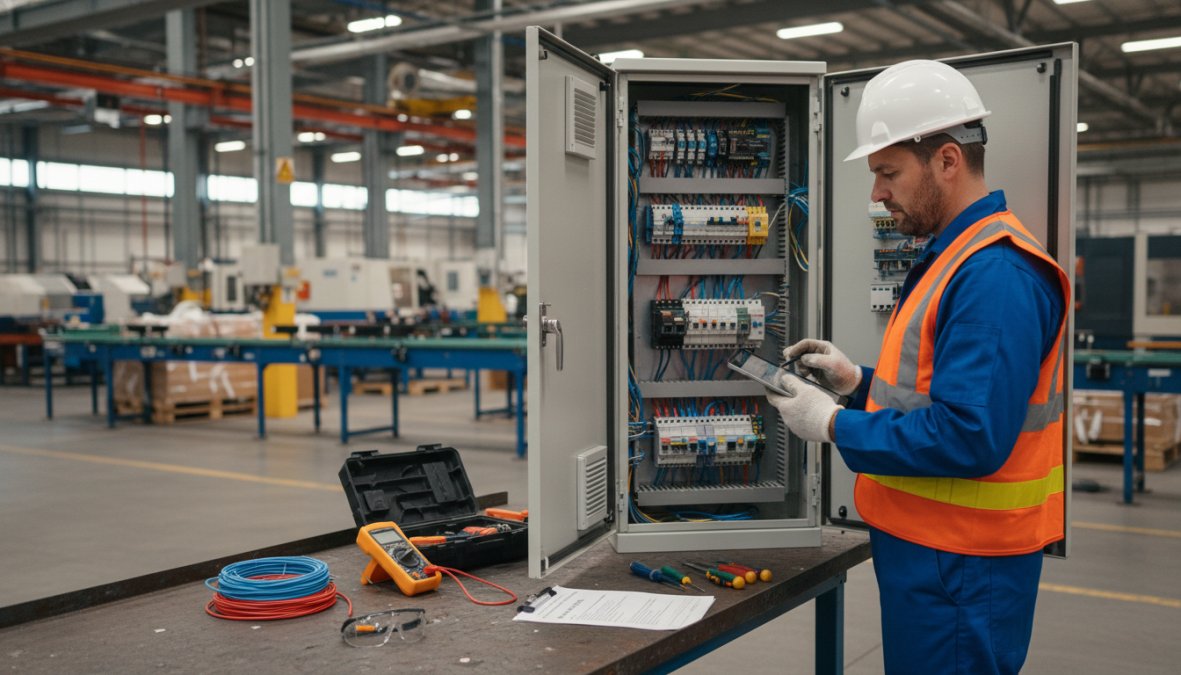
Isolate the affected system safely and document everything visible before any reset attempts. Resetting a fault clears the evidence. Before touching any reset button, record the following:
- Exact fault code or alarm message displayed on HMI or drive
- Time of failure and what the machine was doing at that moment
- Any recent changes: new programs loaded, maintenance performed, environmental changes
- Physical observations: unusual smells, visible burn marks, tripped breakers, warning lights
- Which downstream systems or processes are affected
Photograph the HMI screen, the control panel, and any visible damage. This documentation enables remote support to begin immediately and gives an on-site technician a head start.
Step 2 - Remote vs. On-Site Decision Matrix
The remote vs. on-site decision comes down to three factors: whether the fault is software or hardware in origin, whether a qualified operator is available to execute guided steps, and whether the required diagnostic equipment exists on-site.
| Situation | Recommended Approach |
|---|---|
| Fault code with no physical damage, operator available | Remote support first |
| PLC program corruption or communication error | Remote support first |
| Visible component damage, burn marks, or blown components | On-site technician required |
| Unknown fault, no fault code displayed | On-site technician required |
| Obsolete equipment with no remote access capability | On-site technician required |
| Drive or servo requires physical swap and recommissioning | On-site technician required |
Remote support is faster when it works and significantly less expensive. On-site diagnostics are necessary when the fault has a physical origin or when the system lacks network access.
Step 3 - Engage Field Service Technician or Send Component for Repair
Once escalation is warranted, decide whether to dispatch a technician for on-site repair or remove the component for depot-level repair. On-site repair suits failures within the control panel that don't require specialized bench equipment. Depot repair is appropriate for component-level failures in servo drives, VFDs, and PLCs where board-level rework, calibration, or firmware restoration is required.
Flexa Systems handles this second path with free diagnostics and a clear repair estimate before any work begins, removing the guesswork from the cost side of the decision.
How to Reduce Industrial Downtime Before and After an Emergency
The most expensive emergency repair is the one you could have prevented. Downtime reduction is built into maintenance schedules, spare parts strategy, and equipment lifecycle planning, not just reactive response.
Preventative Maintenance and Calibration Services
Preventative maintenance for automation control systems focuses on components most likely to degrade over time: capacitors in VFDs and servo drives, cooling fans in PLCs and MCCs, battery-backed memory in controllers, and encoder feedback systems. According to the U.S. Department of Energy's guidance on industrial maintenance practices, predictive and preventative maintenance programs consistently outperform reactive maintenance in both cost and equipment longevity. A practical schedule should include:
- Annual inspection and capacitor testing for VFDs and servo drives
- Quarterly cleaning and thermal imaging of MCC compartments
- Semi-annual battery replacement for PLC memory backup
- Regular backup of all PLC and HMI programs to off-device storage
Spare Parts Sourcing and Obsolete Equipment Planning
Spare parts sourcing is where many facilities discover a problem only after it has already occurred. When a manufacturer discontinues a product line, facilities must choose between expensive secondary-market units, reverse-engineered alternatives, or full retrofits.
Component-level repair is the smarter path, it extends the life of existing hardware without requiring a full modernization project. Repair providers specializing in legacy equipment can often restore units that OEMs no longer support, particularly relevant for older Allen-Bradley, Siemens, Fanuc, and Mitsubishi platforms. Treating repair as a primary MRO strategy rather than a fallback can extend equipment life by years and defer capital expenditure.
Industrial Automation Repair Cost Factors: Repair vs. Replacement Analysis
The repair vs. replacement decision is where facilities most often make expensive mistakes. The instinct to replace feels safe, but the actual cost comparison rarely favors replacement when repair is viable.
Key cost factors driving the analysis:
- Component cost: A new VFD for a large motor can cost several thousand dollars. Component-level repair typically costs a fraction of that.
- Lead time: New automation hardware can carry lead times of weeks or months. A repaired unit can return to service in days.
- Integration risk: Replacing a controller or drive often requires reconfiguration, parameter re-entry, and recommissioning, all of which risk introducing new faults.
- Warranty: Flexa Systems backs repairs with a 2-year warranty, competitive with or better than many new units.
The general guideline used by experienced maintenance managers: if repair cost is below 60% of replacement cost and the unit has no history of repeated failures, repair is the correct choice. According to the Association for Manufacturing Technology's resources on equipment lifecycle management, lifecycle cost analysis consistently shows that repair-first strategies reduce total cost of ownership across most industrial automation asset classes.
Safety Compliance and Liability Protocols During Emergency Repairs
This is the section most emergency service guides skip, and it matters most when something goes wrong.
Emergency repairs must comply with OSHA lockout/tagout (LOTO) standards, NFPA 70E electrical safety requirements, and site-specific safety protocols. A technician who bypasses LOTO procedures to speed up a repair creates liability exposure for both the service provider and the facility. Speed is not an acceptable reason to compromise safety compliance.
Non-negotiable protocols during any emergency repair:
- Full LOTO verification before opening any control panel with live voltage
- Arc flash PPE appropriate to the incident energy level of the equipment
- Written work permits for energized systems above NFPA 70E thresholds
- Documentation of all work performed, components replaced, and test results
- Post-repair functional testing before returning equipment to production
Facilities should verify that any third-party repair provider carries appropriate liability insurance and that technicians are trained to applicable safety standards. A repair operation that works to documented quality management procedures provides additional process assurance. As documented in OSHA's standards on control of hazardous energy, lockout/tagout violations are among the most frequently cited electrical safety failures in manufacturing, and emergency conditions are explicitly not an exemption from compliance requirements.
Types of Automation Systems Covered by Emergency Repair Services
PLCs, HMIs, VFDs, Servo Drives, and Motor Control Centers
Emergency repair coverage spans the full range of industrial automation hardware.
Programmable Logic Controllers (PLCs): Processor modules, I/O cards, power supplies, and communication modules from platforms including Allen-Bradley, Siemens, Mitsubishi, Omron, and GE Fanuc. Component-level PLC support extends the life of legacy systems no longer available new.
HMI Repair: Touchscreen panels, operator interfaces, and display units. Common failures include backlight failure, touchscreen calibration drift, and communication port damage, many addressable at the board level.
VFDs and Servo Drives: Drive failures typically involve power stage components, gate driver circuits, or control boards, all addressable through component-level repair.
Motor Control Centers: MCC bucket repair including contactor replacement, overload relay replacement, and bus bar inspection.
Mechatronic Repair: Systems integrating mechanical and electronic components, including servo-driven actuators, robotic joint drives, and encoder-feedback positioning systems.
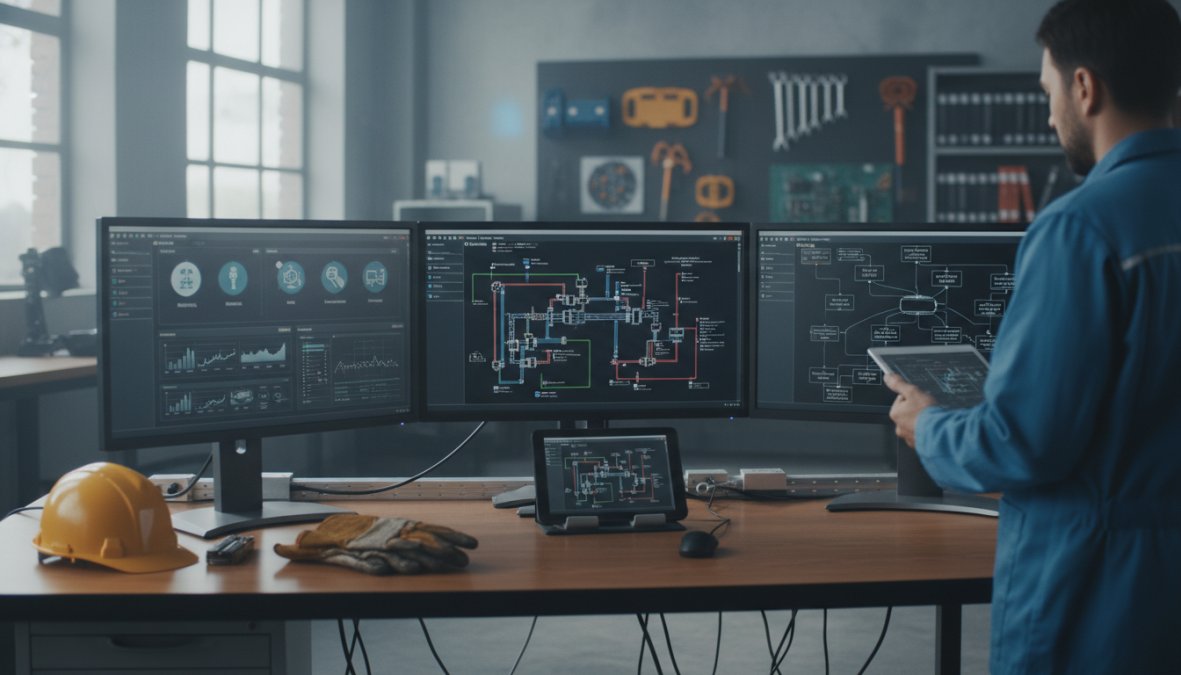
Flexa Systems performs component-level repair across all of these categories, serving facilities nationwide from its base in Lewisville, TX. Free diagnostics, a 2-year warranty, and 24-72 hour rush service make it a practical choice for facilities that cannot afford extended downtime.
How Emergency Industrial Automation Repair Services Restore Production Continuity
Production continuity is the actual goal. Everything else, the diagnostics, the triage, the repair decision framework, is in service of getting the line running again safely and reliably.
Emergency industrial automation repair services restore production continuity through speed, technical depth, and parts availability. The fastest providers combine on-site field service with in-house repair workshops, eliminating dependence on external subcontractors or OEM parts queues. OEE metrics recover faster when repair addresses root cause rather than treating symptoms.
In practice: a facility calls in a fault at 2 AM, remote diagnostics identify a failed drive control board within the first hour, the component ships for rush repair or a swap unit is dispatched, and the line is back in production within 24-72 hours rather than waiting weeks through standard procurement.
According to the Manufacturing Institute's analysis of unplanned downtime impacts, facilities with established emergency repair protocols and pre-qualified service partners recover significantly faster than those managing the process ad hoc. Pre-qualifying a repair partner, establishing an emergency contact protocol, and maintaining a minimum spare parts inventory are the three steps that most reliably compress recovery time.
Unplanned automation failures do not wait for convenient timing, and the cost of a slow response compounds quickly. Flexa Systems provides component-level emergency repair for VFDs, PLCs, HMIs, and servo drives with free diagnostics, a 2-year warranty, and 24-72 hour rush service options. Facilities that repair rather than replace save up to 70% compared to new equipment costs while getting back online faster. Get a quote from Flexa Systems and restore production continuity without the lead times or expense of full replacement.
Frequently Asked Questions
What is considered an industrial automation emergency?
An industrial automation emergency is any unplanned equipment failure, such as a PLC fault, VFD failure, or HMI crash, that halts or significantly degrades production. If the failure directly threatens production continuity, worker safety, or causes measurable financial loss per hour of downtime, it qualifies as an emergency requiring immediate industrial automation repair services. Equipment failures on critical single-point-of-failure systems are always treated as emergencies regardless of shift timing.
How quickly can emergency industrial automation repair services respond?
Response times vary by service model. Component-level repair providers like Flexa Systems offer 24-72 hour rush turnaround once a unit is received, making them ideal for shippable components like VFDs, servo drives, and HMI panels. On-site field service technicians can often dispatch same-day or next-day for PLC and control system troubleshooting. The fastest outcomes typically combine remote diagnostics first to confirm the fault, followed by either on-site dispatch or overnight shipping of the repaired unit.
Is it better to repair or replace industrial automation components during an emergency?
In most cases, repair is the faster and more cost-effective path during an emergency. Replacement lead times for industrial automation components, especially Programmable Logic Controllers, servo drives, and HMIs, can stretch weeks or months, particularly for obsolete equipment. Component-level repair services can restore function at a fraction of the cost, often saving up to 70% compared to new equipment. Replacement makes more sense when a unit has failed multiple times, is no longer supported, or when automation modernization is already planned.
What should be included in an industrial automation maintenance plan to prevent emergencies?
A solid preventative maintenance plan should include scheduled on-site diagnostics, calibration services for critical sensors and drives, thermal imaging inspections of Motor Control Centers, and a spare parts sourcing strategy for high-risk or obsolete equipment. Tracking Overall Equipment Effectiveness (OEE) metrics helps identify declining performance before a full failure occurs. Pairing preventative maintenance with a standing relationship with an emergency repair provider ensures rapid response when, not if, an unplanned failure eventually happens.
What are the most common causes of industrial automation system failure?
The most frequent causes include power surges or voltage irregularities damaging VFDs and servo drives, firmware corruption or battery failure in PLCs, environmental factors like heat, dust, and moisture degrading HMI and control boards, and mechanical wear in electro-mechanical components. Deferred preventative maintenance and the use of aging or obsolete equipment without retrofits and upgrades significantly increase failure risk. Identifying root cause during repair, not just replacing the failed component, is critical to preventing repeat failures.


